Wednesday, May 6, 2015

Super Duro

Welcome to the Jungle
Shannon and I are truly fortunate and very lucky. We tell each other this every week. When we first decided to go to an international school we were prepared to go without truly knowing where we would end up. We were fortunate enough to end up in a place that has some of the most unique locations on the planet to visit.

In the past 9 months we have hiked through cloud forests. We have swam with sea lions in the Galapagos Islands. We have hiked up volcanoes and slept at the foot of giant snow-capped
mountains. And now we can add another truly remarkable trip to that list.
Chocolate Leaves

Last weekend, Shannon and I spent out three day weekend in the Amazon Rainforest. THE AMAZON RAINFOREST. As in, the very same one that centered your elementary school science units. The most famous collection of wilderness and animals and plants the world has to offer. I still can’t believe we are afforded that opportunity whenever we want. Anyway, here is a brief account of our experiences.

We woke up early on Friday, intent on getting to the lodge as early as possible. The drive was projected to be about four hours. I have detailed before that while the country is small, our location in the middle of the mountains and the necessity to drive winding mountain roads leads to long drives. In an effort to keep this post interesting but still accurate I’m going to zoom through the next bit. We got turned around on the road and added two hours to our journey there. There may have been a frustrated meltdown or two but the point is we got there.

Quechua Yucca Potions 
When we arrived to our destination, we still had a way to go. That sounds weird but let me clarify. When you are going on a trip to most lodges in the Amazon you have to get there by motorized canoe. There are no roads that lead into the jungle or parking spaces. So we parked our car at a public lot and paid a canoe driver ten dollars to take us a half hour up the river to our lodge. Unfortunately the actual Amazon River does not go through Ecuador so while we were in the Amazon Rainforest, we were on the Napo River. The Napo River is either the largest or the second largest tributary river to the Amazon but I digress.

The river looked exactly as all rivers in the Amazon look on tv. It is dirty, murky, and dark but in a very natural way. As we took our private 30 foot long canoe to our lodge, Shannon and I discussed the creatures that potentially lurked just below us and strategies for escape if the boat capsized. The gist of that conversation is that I would have saved her but she would have used her swimming coach techniques to leave me in the vicious jaws of the first critter to approach. I understood…it was a tough drive.

Caiman Snack Time
When we got to the lodge, we were greeted with an incredible lunch and cold beer. We had heard about the lodge through some friends and it was all inclusive in terms of our excursions, meals, and lodging. After finishing our lunch we were taken by our guide Cesar on a short hike through the jungle. Cesar spoke only Spanish so we were able to practice our Spanish while taking the tour which was nice.

Along our trail, we came across a cinnamon tree and ate the leaves. We came across a giant garlic tree and ate the leaves. We came across a variety of flowers and antibiotic trees that were used for pharmacy pills…and we ate the leaves. Had we not been served lunch I might have been getting skeptical of this whole “all meals included” thing.

Leaf Cutter Ants
The hike was a pretty genuine Amazon experience. Cesar had a machete that he used to cut a path through the thick foliage in some spots. At one point he surprised us all by smacking the back of his machete against a tree. The tree made a loud bang like it was made of steel. “Super Duro!”  he laughed at us meaning super strong. He seemed to have just as much fun as we did.

While we were walking Shannon pointed out that a whole colony of leaf cutter ants were forming a convoy across our path and sure enough, thousands of the little red dudes were going from the river across the path and up a tree. It was almost as if we were in a movie seeing all of the “Amazon scenes.”
Almost Ready!
Towards the end of our walk we found a small caiman, which is like a fresh water jungle crocodile. Cesar threw him a bit of meat and he lackadaisically chomped on it while giving us some serious side eye.

Ready for the Hike
After we saw the animals, we went to the home of a local Quechua family chatted with a woman who lived there. She made us a local drink made of ground up yucca and hot water. She made us some natural chocolate and fed it to us on a leaf. Her hospitality was incredible and her kindness was truly moving.
Then we went outside to do what all Quechua people must learn to do, we fired blow guns! Cesar set up a target for us and we took turns firing wooden darts down an eight foot barrel at a piece of wood. When I shot mine it came out of the blow gun with the velocity and ferocity of a jungle warrior…then took a left turn, missed the target, and nearly killed one of the woman’s pet chickens. My second attempt was no better. Shannon however, fired a strike straight into the center of the target. I suppose I should keep her on my side when we go for hikes.
Conga Ant aka Bullet Ant

When we returned to the lodge that night we were met by more delicious non leaf foods and shared dinner with some of the other travelers who happened to be staying there as well.

The next morning we woke up early for a canoe ride deeper into the Amazon and took another canoe ride to a remote island area. As we got off of our canoe, Cesar decided that he wanted to take a local fruit and paint our faces like local tribes people. It was a little touristy but hey…that’s what we were.
Cesar and Us in the Jungle

We went on a hike and saw a dangerous Conga Ant crawling near Cesar’s hand. According to the internet, which is never wrong, the Conga Ant has dangerous neurotoxin venom in its stinger that causes the most painful sting of any animal in the world. It is supposedly more painful than any scorpion, wasp, hornet, or any other stinging animal.

After avoiding that we found ourselves in some quicksand. We actually got caught in quicksand. Granted, we only sank up to our shins and were never in any real danger but WE SANK IN QUICKSAND!!!
Quicksand!!

After ducking through a few spider webs and seeing some cool birds and insects, we made it up to the top of a hill where Cesar made Shannon a fern crown and declared her the Queen of the Amazon. We took a few nice pictures overlooking a nice part of the jungle and hiked our way back to the canoe.
On our way, Cesar spotted a somewhat swollen branch and climbed up the tree, cut the branch, sliced it open and out came a colony of ants. He suggested we eat them and when we did, they tasted like lemon! Lemon flavored bugs! I could get used to this.

When we got back to the canoe, we got changed and hopped into some tubes to go tubing down the Napo River. We all exchanged some side glances since Cesar himself told us that the river had Caimans and Anacondas but that they probably wouldn’t bother us. The owner of the lodge also assured me that the dreaded Candiru fish USUALLY didn't come that far up the river to where we were going. Some endorsement… That’s the one that…well, click here if you want to be completely horrified.
Howler Monkeys

While we were a tiny bit freaked out, we floated along the Napo for about twenty minutes, through some fast moving water and slower lazy river type stuff. We relaxed while staring above us into the tops of the massive trees wondering what other jungle secrets lied in obscurity.

The Queen and I
After the lazy river float, we climbed back into the canoe and went a little bit further into the jungle. All of the sudden our guide cut the engine and Cesar started making a whooping sound. None of us knew what he was doing or what was going on until we spotted them. A family of howler monkeys inched towards us on the branches and ended up about 20 feet from our boat looking at us with confused expressions. I guess they weren't very used to humans. One of them stared at us with a seriously grumpy face and without moving another muscle, started flexing his brow. It was the strangest thing. I don’t know if it was a friendly gesture or an aggressive one but after a few pictures and looking at them for a while we left.
The Good Life


When we got back to the lodge we spent a nice late afternoon napping and reading on the hammock before dinner, which again was incredible. We ended up packing up early on Sunday and enjoying the lazy but beautiful ride back, which we made in less than four hours. We hiked through the jungle, saw some dangerous insects, fed a caiman, got mean mugged by some howler monkeys, ate jungle food, shot blow guns, got our faces painted with natural fruit dye, and one of us was crowned royalty. It was a “Super Duro” way to spend our three day weekend.


Inaquito

I don’t remember if I’ve addressed this in a previous post or not, but either way here goes.
If you want an imported good such as a box of Frosted Flakes or some other US good, it is extraordinarily expensive. That’s just part of the price of living in a country that has somewhat limited trade flexibility with the United States. However, if you want produce it is cheap. Like super crazy cheap. Like stupid cheap.

Every Saturday, Shannon and I take a short trip to the Inaquito Market. Surrounding the market is a series of little tiendas that vary in their specialty. I would say that about a third of them are florists where you can buy two dozen gorgeous roses for $4 or so. Another third of them is assorted plastic goods such as Tupperware and pitchers and the like. The last third is liquor stores.

I won't show you what it looks like
before it gets to the plate.
When you walk into the market which is essentially a large warehouse, you see a food court to the side where you can buy hornado. Hornado is pretty much the only thing you can buy. Hornado is an typical Ecuadorian plate that consists of fried bite sized pieces of pork. You also get a sliced avocado and choclos large kernel corn, all for about $3. The whole raw dead pig is usually hanging on a hook or on the counter. They will carve it for you depending on what you want and then fry it up. It sounds gross. It looks gross. It kind of is gross. But, the food is delicious.

When you walk past the cafeteria area, you find a variety of stands that serve as makeshift butchers. None of the meat is wrapped or refrigerated so we haven’t really taken them up on their fantastic prices but we hear the quality is good.

Then, past all of that is the goldmine. You arrive at a flea market style setup with rows and rows of fresh fruit, vegetable, and spice stands. In the spice stands you can buy all of the spices you need from curry to chili pepper, to cayenne pepper, to ginger, to well..you get the idea. They usually sell a bag that is a quarter of a pound for a dollar or so.
Rows and rows and rows of delicious options

The fruit and vegetable stands are equally as appealing. The owners try to give you a gringo price and expect you to haggle but sometimes we find that it’s hard to argue over .10 worth of a price when you are getting such a great deal. For example, we usually get 6 or 8 oranges for a dollar. We buy a pound of strawberries for a dollar or less. We get 6 apples for a dollar. We buy a bushel of peppers for a dollar. Fresh heads of lettuce, cabbage, parsley, celery all cost about .40 apiece.
All in all we bring a backpack and two reusable grocery bags and buy about 15 pounds of produce to use for the week for cooking and snacks and we spend less than $20. It’s another unexpected advantage of living here. I’ll take the $7 Frosted Flakes for this deal any day.


International Festival

One of the cool things about working in our school is how different all of the students are. To clarify, in our last school we had a very multicultural student body. We had quite a few Haitians, Dominicans, Puerto Ricans, and people from a dozen other places. However, the mere nature of this school and the classification of “International” really brings the multicultural aspect to another level.
The biggest difference among our student body here vs what we experienced in the states is that in the US, everyone from another background was trying to fit in. There was a mainstream culture and expectation and here it seems that everyone has a huge sense of nationalism and pride in their differences. It’s pretty refreshing.

The embodiment of thi

s sentiment took place about two weeks ago when the school held its 48th (or something) annual international festival. The festival was a series of carnival games ran by students, cultural dances, and of course food tents.

I was elected among the high school students to a position manning the dunk tank. Having previously been the object of scorn and tongue biting focus while sitting on a dunk tank platform before, I knew the one key to being the bag of tea to a dunk tank is to go early. There is a trade-off of course. If you go in too early, you get a bit of biting cold hose water to cushion your fall. If you go later, the water is warmer (who knows why…) and there is often hair and other undesirable stuff floating next to you. 
Some friends of ours taking aim after I
was off of the tank
Armed with this wisdom I chose the early time slot and seemingly forgot to account for altitude and cold frigid mountain weather. After a line of kids dunked me in the frigid water for about 40 minutes, I retreated to my classroom to put on dry clothes before the wet ones turned into a frozen sheet. Also yes, Shannon dunked me.


Food, glorious food!
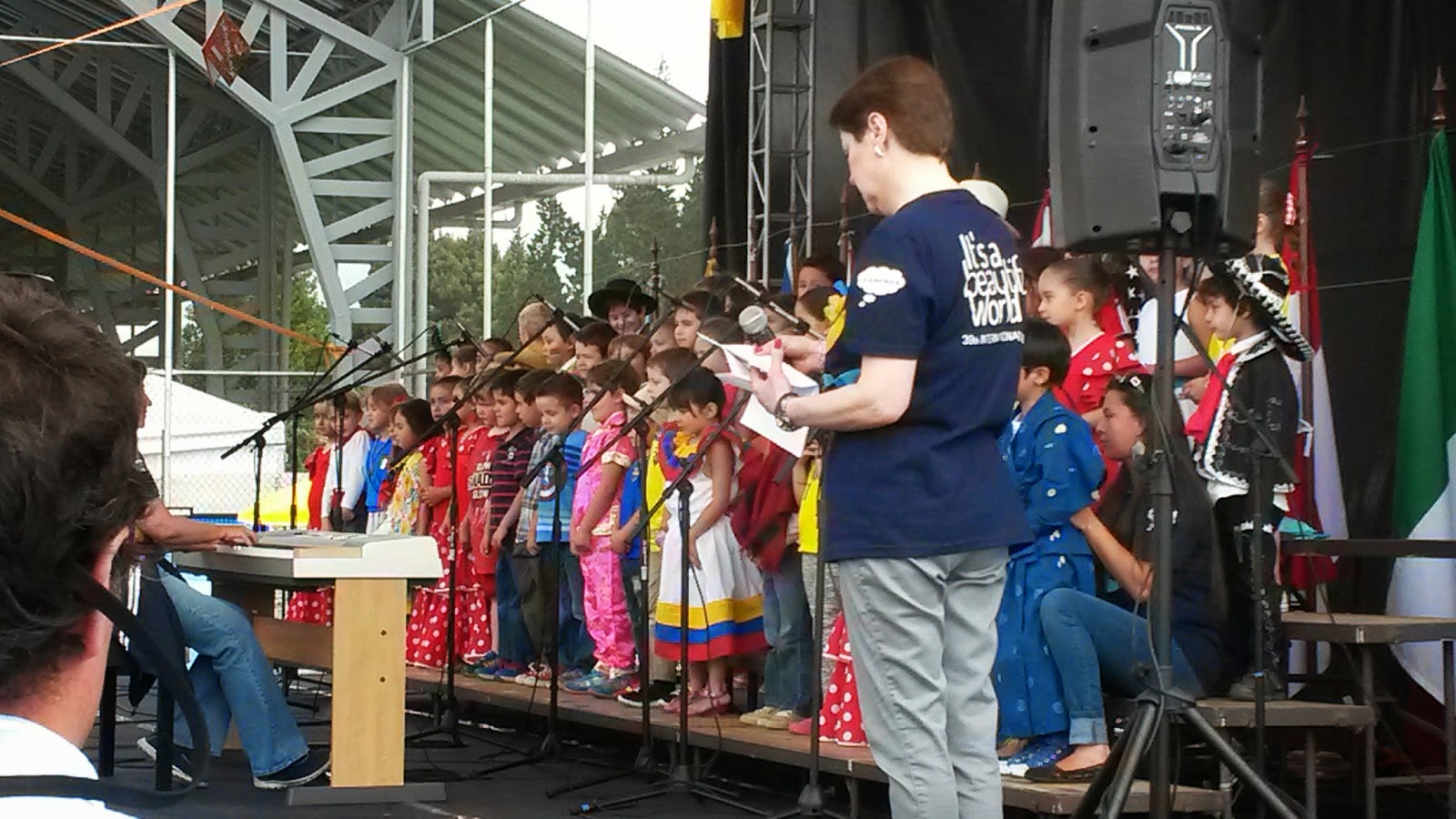
After putting on the dry clothes I went up to the main stage area. Allow me for a moment to paint you a word picture. The whole setup is outside in a large flat tennis court style area. There is a stage up front where students are performing a variety of cultural dances, songs, and rhythmic interpretative shadow boxing. First, the 6 year olds perform an adorable rendition of a flamenco dance. Then the 16 year old boys play some fancy song on their guitar. Most of what is happening is in a variety of languages that I didn't speak but the feeling of pride and communal bonding and respect was omnipresent.

So many options!
Surrounding all of this extravagant celebration are tents. Many many tents. Each tent is selling food or goods from their local area. The Ecuador tent is selling llapingachos and hornado along with Ecuadorian chocolate. Canada was selling Maple Bars. Mexico had tostadas and burritos. China had pork and egg rolls. Indonesia had some sort of heavenly curry/soup/mush of delight. My absolute favorite however was Argentina. Argentina was selling sandwiches of thick cut Argentinian beef. Simple yet divine.
Young flamenco dancers

All in all, I caught a cold, Shannon dunked me, kids played games, and we stuffed ourselves with food from all around the globe. It was truly a unique and great experience. I eagerly await next year’s 49th (or whatever) edition.


Wednesday, April 22, 2015

Oh Susana, Enséñame

When Shannon and I found out we were moving to South America, one of our first thoughts was how we were going to get our Spanish speaking to a proficient level. I had taken a few years throughout my own schooling as did Shannon but we both realized it wasn't quite enough. We also had a little bit of an opportunity to practice our limited skills due to the fact that we both lived and worked in Florida. But again, our Spanish was nowhere near the level it needed to be if we were going to be living in a Spanish-speaking country.

When we first got to Ecuador, we were quickly thrown into the fire and learned quite a bit through necessity. We developed a very rudimentary vocabulary based on our conversations with taxi drivers, grocery store clerks, restaurant waiters, and at the market while haggling for better prices. The school offered a one day per week, two hour class on Mondays but with the large class sizes and the clear annoyance of the teacher being tasked with teaching us, we decided that the class was not for us.

That was about all we could afford to spare with regards to time. We were so overwhelmed by the cultural differences, adjusting to new jobs, furnishing our home, finding our home, getting Howie here, and eventually coaching sports. Free time is not something one should expect when they first move to a new country.

About three weeks ago however, we realized that we were settling in to a somewhat normal routine and actually found ourselves with a tiny bit of time. We decided to take that time and devote it towards learning the language of our neighbors. We both discussed how not only would it be rude to refuse to assimilate in some what to the country which we resided, but it would also make our lives easier if we learned Spanish. Another consideration is that we both felt we would be highly disappointed in ourselves if we lived in another country and never mastered (to some level) Spanish. Language and culture acquisition were two of the biggest reasons we decided to go overseas and we were set to make some progress.

After talking to a few teachers who had similar feelings about learning Spanish, we found out that the language schools here are a booming business and relatively reasonable. People looking to learn Spanish in Quito have a myriad of options. You could go to a language school once or twice per week for $7 per hour per person. This seemed absolutely reasonable to us but the drawbacks were that you would be in a larger class instead of in a more intimate one on one situation, and we live about a half hour to forty minutes away from the school. I could certainly see myself coming home after a long day and deciding to forego the $7 and stay home. The other option, the one we chose, was that you could have a Spanish teacher come to your home and give you a private lesson for one hour per session for $10 per person. We obviously decided to choose that option.

In the few weeks that we've been working with Susana, our private tutor, our Spanish has progressed quite a bit. She assesses us on the fly for what we know and adjusts the lessons accordingly instead of fitting us into a neat little box of beginner, intermediate, expert. She prepares homework assignments, and instead of simply lecturing us, she converses with us. We have conversations at the dining room table about a variety of topics at our level.

It has been a wonderful experience so far and I look forward to continuing to progress.

Have a Nice Lunch

Today during lunch, our Middle School Principal walked up to a group (myself included) of teachers eating lunch. He had his hand over a cup much like a person would if they were walking with a cup of hot soup to make sure it didn't spill.

When he got to the table we asked what was in the cup and he removed his hand to show a nice little black scorpion in the bottom of the cup. Apparently a teacher found it in one of their classroom during a class.

There is no long winded allegory involved in this story, I just found it interesting that even up in the mountains of Ecuador we find stuff like this roaming our halls and classes.


Monday, April 13, 2015

Follow Me Mr. President

Every day between 6:45-7:15am, the President drives by. I have heard that he is taking his child to school. I have heard he’s on his way to work. Who knows. All I do know is that when he drives by, it is with a full motorcade of about 4-6 motorcycles and 3-5 tinted out black SUVs. I also know that a week and a half ago, I became part of that motorcade.

If you've ever seen a motorcade or even any TV show or movie set in Washington D.C, you know the drill. A scout vehicle rides up ahead and stops traffic so the rest of the convoy can go forward. The President naturally gets precedent. This is no different in Ecuador. Also, the implication is that if you mess with the motorcade, you will be shot or thrown in jail with quickness. This is also no different in Ecuador.

So to set the scene, we live about 10 minutes away from school by foot. It’s a smoggy uphill walk but a nice one most days. On this particular day, I was running late and also planned on going to the grocery store after school. Shannon was sick and I was planning on picking up some stuff for her to make soup. As a result, I took the car to work.

At the top of the hill, where we normally turn right, I was yielding like a good citizen when traffic stopped coming. I figured it was a day like any other and it would be my time to dart into the road and merge while there was a momentary lapse in traffic. Traffic is terrible in Quito and you have to take every opportunity you can to get on to the road you desire. I did not see that the reason for the break in traffic was the Presidential motorcade scout motorcycle. As I made my turn I quickly realized that I had merged directly into the motorcade. There were scout motorcycles in front of me and black SUVs behind me. I was terrified for my life and for my prospects as a new character in the Ecuadorian vision of Shawshank Redemption. Luckily for me, we cruised along for about five minutes without anyone stopping me. I made my right hand turn into the school parking lot and no one bothered me once. I effectively had the President escort me through traffic to get to school quicker with no consequences.


Just another day in the life of an ignorant American abroad.

Tuesday, March 31, 2015

Wedding Research Weekend

This weekend kicked off our spring break vacation and Justin and I decided to start doing some preliminary wedding venue scouting and research. Our destination: Otavalo, an indigenous rural countryside marked by rolling green hills, cloud-shrouded volcanoes and the immense lake, Lago San Pablo. Otavalo is an easy 2 hour car ride out of Quito. It is an agricultural area, checkered with dairy pastures and corn fields. The neighboring town of Cayambe (named after one of the massive volcanoes in the area) is known as the world’s largest exporter of roses.

Drive to Otavalo
The drive out of a town is a pleasurable one as you leave behind the smog, dust, concrete and car horns and are gradually enveloped in green fields and soaring mountains. Justin and I both remarked several times to one another, now THIS is Ecuador. This is what we came to see. Our weekend research/retreat had four destinations: Cabanas del Lago, Hosteria de PuertoLago, (2 lakeside accommodations) Hacienda La Compania, (the estate home of a rose plantation) and a private family estate, Hacienda Pichona which all be described below.

We only experienced one small complication on our ride – a traffic stop. We’ve been told these are routine on Friday afternoons and evenings and are sometimes a way for the policia to take cash bribes in exchange for not issuing tickets. We’ve also been told that, similar to how they deal with power bills for example, they don’t play around. Driving during Pico Y Placa? Straight to jail. Driving without a license? Straight to jail. We both felt a pang of worry when we realized that all the other cars were being waved through, but the policeman had flagged down our car to stop. He asked for Justin’s license. Justin handed over his license. Phew! So far so good. Those 2 miserable days spent in purgatory at the DMV now seemed so worth it. Next he asked for matricula (registration). Now this might be a problem. If you’ve been following our car updates, you’ll know that we still don’t have the car in our name. We do have the registration but it’s under the prior owner’s name. In the US, this would clearly warrant further questioning. Justin hands over the matricula. Moment of truth. The policeman glances at it and hands it back. He asks Justin if the tint on the windows is new or original. Justin tells him it’s original. He nods and waves us on our way. YAY!! No locked up abroad today!

1st stop: Cabanas del Lago

Cabanas del Lago


Open air restaurant at Cabanas
After driving through a poor, run down barrio we arrive at the entrance to the property.  It is stunning. The property consists of 27 separate cabins, each complete with their own front porch and fireplace. The landscaping is absolutely beautiful and the chirping of birds and clicking of frogs is everywhere. The main building houses a reception area, and a restaurant that overlooks the lake and nearby mountains Mojanda and Imbabura. A section of the restaurant is only walled on three sides by glass, the fourth wall being completely open the water. On the far side of the property is a mini marina featuring jet skis, kayaks, and other deportes del agua. Ducks swim by the dock as we eat dinner.
After dinner, an employee stops by each cabin and lights up the fireplace. It is incredibly peaceful. The next morning over breakfast, our waitress Paulina invites us to stay at her house next time we visit. She takes my email address. When she hears we are planning a wedding in the area she is overjoyed. She kisses us both and asks Justin if she can have a dance with him at the reception. He happily agrees.

2nd stop: Hosteria de Puertolago

Cabins at Puertolago
Again, a very humble drive to the entrance of this property, located on the same lake, several kilometers away. This property is described as a country inn and the cabins are much more rustic looking. Each room also comes with a wood fireplace and all balconies and porches face the water. The view from this side of the lake is even more breathtaking. The enormous mountain Imbabura looms directly in front of the property, it’s base looks like a quilt of different shades of green and it’s top is hidden somewhere up in the distant clouds. It is unreal. The landscaping here is much more
View from the balcony at Puertolago
modern and manicured, giving it an almost Disney-like feel. Nestled under the overhang of the roof above our cabin sits a mourning dove protecting her modest nest. She doesn’t move from the nest the whole time we are there. There is also a waterside restaurant here and though it lacks the open air section of the first place, it compensates with a well-equipped billiard room. The owner of the property is an English-speaking ex-Miamian Cuban who explains he left Miami because there were too many Cubans. We share with him some details of the wedding we are planning. He does not ask Justin for a dance at the reception.

3rd stop: Hacienda La Compania and Rose Plantation
Hacienda La Compania


Rose Fountain at La Compania
This is a private family residence/museum where the owners of the rose plantation down the road live. We had made an appointment for a Sunday morning breakfast in the grand dining room. We are served warm bizcochos and queso (the traditional biscuit of the region), humita (steamed cornmeal served in a corn leaf), ham and cheese, croissants, fresh papaya, watermelon and pineapple, coffee, and three different types of fresh-squeezed fruit juices.  The matriarch of the family joins us at our table. We are her only guests, apart from her daughters, son in law and grandchildren who all eat their breakfast at a nearby table. After breakfast she gives us a tour of the property including an original 17th century Jesuit chapel, and an old granary-turned-showroom for all the 70 varieties of roses grown at the plantation. And though it is a cold and rainy morning, it is a
pleasant visit. We finish our tour with a private visit to the rose plantation where we get to walk through rows and rows of roses varying in color and height, some plants even taller than Justin.  One greenhouse is filled solely with red roses. The guide explains this is their Valentines greenhouse.


4th and final stop: Hacienda Pichona
Hacienda Pichona
This is another private residence that serves as the family’s weekend home. It is a combination of a 5-bedroom estate, complete with its own chapel, and stables for its horses, rabbits, chickens, and llama. The front courtyard is made of round, grey stones with grass and algae growing in between the cracks, it makes the place look like a modern-day castle. I think it would make a beautiful backdrop for wedding photos. We hear birds chirping and a rooster crowing in the distance. Other than the sounds of nature it is incredibly quiet and tranquil. And the massive living room and fireplace would make an intimate setting for our wedding party to socialize.


I’d say our weekend scouting trip was a huge success and we feel we are getting closer to making some decisions. And to our future wedding guests I will say this, you are all in for an amazing, beautiful time!

Grilled Tea and Other Non-Electric Delicacies

Ecuador may be considered a country that is still developing modern conveniences. One of these conveniences is the platform for online bill pay. Most people still pay their bills here in cash and in person. Heading down to the ServiPagos office once a month to pay your electricity and phone bill is common practice and a standard service offered by messengers and empleadas. But this is not convenient because even just withdrawing your own cash out of an ATM to give to the messenger to pay your bills is at times a multi-step process. You are only allowed to withdraw $100 at a time from an ATM, and the government imposes a daily limit of $200 cash withdraws. So for these reasons I’ve attempted to pay most of our bills online. This is handled directly through our bank account, which is already connected to basic service providers.

However, when our bank remodeled their website a couple weeks ago, things went awry. I attempted several times to pay our electric bill online, and I kept receiving an error message that the balance paid had to be greater than zero. “Huh,” I thought to myself, “I guess I already paid it and just forgot to write it down.” Wrong. This error message was due to the website not being compatible with Google Chrome (a fact I figured out later) and the bill had not, in fact been paid.

Imagine my confusion when I got home from work on Thursday night to a dark house. I angrily blamed the construction crews working across the street day in and day out. They must have cut a line or downed a transformer. What nerve! Never had I imagined that the power had actually been shut off. After all, the due date was a mere three days prior. Of course they couldn’t shut it off that quickly. In the US, you can go months without paying your electric before they shut it off. The electric company can’t have people freezing to death on them, now can they?

Lesson learned: Ecuador does not play around with prissy little “grace periods.” You pay your bills, or you get shut down. Like, immediately. Now I know.

I was taken back to our first weeks in Ecuador when we had no hot water and had to take cold sponge baths and then scurry into bed into layers of blankets, teeth chattering. As the sun began to quickly set, I rounded up all the candles I could find and put on an extra pair of sweat pants and thick socks to brace for the arctic 60 below temps. “Justin,” I squeaked under blankets and with a scratchy voice, as I was right in the middle of a nasty chest cold. “I think I didn’t pay the power bill.” “Okay” he said. “I tried to do it a couple of times online and it just kept giving me an error message and then I just forgot about it,” I explained. “And we can’t get online to pay it now because our Wi-Fi is out and we have no saldo and also both our cell phones are almost dead,” he added. I nodded pathetically.


So in typical hero fashion, Justin dashed up to the school to logon to their computers and try to get our bill paid. Fortunately, the school pays their electric bill regularly. And though he was able to finally get a successful transaction, we were still without power for the rest of the night and the next morning. Justin arrived back from basketball a couple hours later to a dark house and me straining to read by candlelight. I told him I was dying for a cup of hot tea but since the stove couldn’t function without electric either I was out of luck.  “I can grill it!” he said, “The grill is gas; I can put it on the grill.” I thought this was hilarious and a bit ridiculous but was desperately wanting some hot liquids. So sure enough, Justin went out onto the porch in the pitch black night and without the glow of his cell phone to light his way, he fixed me a kettle of piping hot tea on the gas grill. And he never once gave me a hard time about forgetting to pay the electric. That my friends, is love.

Rice

I feel a common theme in this blog has been depicting many of the differences that Shannon and I are experiencing while living in Ecuador. A few times, we have touched on the socioeconomic differences that we have encountered. While it’s always fun to write about ziplining and hiking up volcanoes, I would be remiss not to tell whoever decides to read this of some of the more difficult conditions many people in Ecuador live in; things that are in our face every day.

We have detailed in previous posts the shanty towns comprised of homes made with spare plywood and sticks. We have shown pictures of crumbling cement structures with graffiti on them that resemble bombed out Dresden that serve as some of the “nice” places people here live in.
We have spoken a little bit about the children no older than 3 or 4 being forced to sell candy or vegetables at intersections instead of going to school just so they can help contribute a few handfuls of change to the family’s meal that evening.  

Something that I saw this morning while walking Howie the dog broke my heart. We frequently see people digging through trash to find recyclable bottles that they can turn in for a few cents. Today, I saw two women doing that while a little girl no older than 2 years old sat quietly behind them. She was covered in dirt and soot and wore a shirt that was stained and torn and probably also found in the trash. She looked at me as I passed without any expression.

When the two women she was with pulled out a styrofoam carton with some rice and vegetables in it, they gave it to her to eat and continued their search for old beer bottles. Her eyes lit up like it was Christmas morning. There’s no telling how long this child had gone without a meal, or how long she would go before her next but in this moment cold dirty old rice in a carton covered in grease and coffee grounds made her day.


I’m not one to preach to other people. I’m not one to pretend that one short experience can define a person. I may forget about this girl two weeks from now. I hope not. I guess I’m just writing this as a way to show people who aren’t here what it can be like to live in a country where many citizens are forgotten. I suppose that isn’t a very unique story among many countries in the world but it was a unique experience for me. I guess I’m writing it for the same reason I write everything on this blog, so I don’t forget. The whole thing was over in less than 8 seconds but in that right now, in this moment, it has made a profound impact on me and I hope it’s something that I never forget. I’ve lived a very good life. I have never been in a situation where a cup of dirty trash rice made my day. I want to remember that for as long as I remember anything. 

Back of a Cop Car in Ecuador

Thank you Mr. Officer
This is the story about how a day at a spa ended up with Shannon and I in the back of a cop car on a rural mountain road with no cell phone signal and no way out. Every word of that last statement is true. However, at the same time it is also misleading. Let me explain.

After working very hard to get settled in, coaching sports, and fitting in to new job roles at school Shannon and I were really looking forward to a nice vacation over spring break. Or to be more accurate, a few smaller vacations spread out over spring break. Everything was booked and when Friday afternoon rolled around we were out of school before the kids.

Our first vacation was a short weekend trip up into the mountains of Otavalo, which I believe Shannon is writing about so I will leave that story to her. We arrived back at home on a Sunday afternoon with plans to spend all day Monday at Termas de Papallachta. Papallachta is an area that is well traveled by tourists and locals alike. It is an amazing layout of natural thermal hot springs with a spa and resort built around it. We have been hearing about it for about four months and wanted to check it out. We set out yesterday morning with a plan to spend the day in some hot springs in the mountains, get some lunch, and maybe even a nice massage. It was a nice day trip planned out for us and a nice way to let off some steam.

We left at about 7 in the morning and drove out of Quito and up winding mountain roads. The view was incredible at every turn. Ecuador is truly one of the coolest places to drive in terms of fun winding roads and gorgeous views.

After driving for about an hour we heard a quiet and subtle clicking from our car. It worried me a little bit since we had been driving it all weekend and it was an automatic going up mountain roads. Shortly after, the car drifted to a stop on the side of the road. It was overheated and at least temporarily dead. I looked at our GPS and realized that we were ten minutes away from the spa, a phone signal, and civilization in general. Of course we were. When I opened the hood I heard the coolant boiling and after letting it cool for a few minutes figured that if we could get the engine to cool down, we could make it up to Papallachta and call a mechanic. We were without any way of calling anyone since we were up in the mountains in an off the beaten path area with no cell signal I resolved to get the car there and figure it out later. After a few minutes I lifted the cap to the coolant canister and boiling hot coolant flew up into the sky like a child’s volcano project. It coated my face, hands, the hood of the car, and parts of the overheated engine; which of course led to tons of coolant burning smoke.

I have a very limited knowledge of cars. It was very apparent to me at that moment when I wiped the coolant off of my face and saw the warning on the canister saying DO NOT OPEN CAP IF CAR IS OVERHEATED. Oh well, I was still determined to get the car to civilization and to a place where we could call for help. After all, it was only 9am and we could still salvage this day! Or so I thought..
After getting the car to cool down we were able to start it back up and continue our journey. Only…it got us around a corner and no more than 3 minutes of driving time before dying again. In my head I thought that if we could repeat this process three more times we’d be there. We were so close! But after allowing it to cool down some more, and realizing that we were still without cell service I tried to start it again and it would not turn. We were stranded.

Let me paint you a word picture. We are up in the mountains on a rural road where we see one car every seven minutes or so, and that car is a supply truck full of cement blocks or rocks or other such things that a child would envision as they played with their newest Tonka. It starts to rain which helps with the car overheating but does not help our internal temperature as it is about 45-50 degrees with a strong wind. We are within a few minutes of driving to the destination where massages, good food, and soothing hot water await, yet we are too far to walk. We are parked uphill just around a bend on a highway that causes close calls every time a car rounds the corner and sees us. We are without a cell signal. We are without any food. We are in a country where we are passable but not fluent in the language.
Sitting in the back of the cop car, clearly
amused at what the day has thrown our way

So after realizing what we are up against, we sit dejected on the curb out in the elements as to minimize any chance of being smashed to bits when a cement hauling grown up Tonka truck winds the bend and obliterates our car, which by the way we still don’t have all of our final paperwork to. Yes we purchased it December 19 and paid in full at purchase time.

After waiting for about twenty minutes and having no luck turning the car over a nice man named Jhonny pulled over and began trying to tinker with the car to help us out. We were fortunately parked near a stream so we filled some water bottles and poured it in with the coolant with the hopes we could cool the car and get it running to a place where we had cell service. Jhonny spent about twenty hard working minutes with us which unfortunately led to no progress. He vowed to call 911 as soon as he had cell service and get us some help and was on his way. There we sat again hoping to see a tow truck passing by or some other sign of refuge as we thought of the massages that might have been.

Coppers standing guard
About  a half hour after that, two police officers showed up and asked us what was wrong. They had received a call from Jhonny and came to investigate. After looking at the engine with raised eyebrows, it became apparent to me that they knew as much about repairing a car as we did and they suggested we go with them to find a place where they had a signal so we could call a tow truck. We tried persuading them to go by themselves to make the call but the cops insisted that we talk to the tow truck driver to negotiate a price. They were extremely persistent. We tried sending one person with the cops and leaving one with the car due to the fact that we were in a country where stuff gets jacked all of the time. They again rebuffed our requests and demanded we both go.

This is how we ended up in the back of a police car in rural mountain Ecuador instead of at a spa. They drove us up the mountain and called a friend of theirs who was a tow truck driver and then turned back around and let us out. No negotiating was to happen. They drove us back down the mountain and to our cars and said the tow truck driver would be there in an hour. In what is either the most chivalrous mountain act I have ever seen or sheer laziness, they both sat in their cop car and dozed off watched over us while we waited.   
Pepe finally decided to show up

One hour turned to two. Two turned to two and a half or three and eventually a 3 foot 11 inch man named Pepe came and strapped our car up to his truck. He drove us back to Quito while speaking and laughing like a tiny Hispanic version of the Joker for an hour and a half. We stopped to say hello to his cousin. We stopped for gas. He orchestrated a cocaine sale on one of his three cell phones. Our car alarm went off every 90-120 seconds or so due to the bumpy roads, even when we turned it off. He invited us to his house for fried fish. Then he charged us $150 and dropped us off.

Pepe completing his drug deal
When we were dropped off we told the story to our mechanic. He told us a story of a couple who broke down in almost the same spot a month or so earlier. When two good samaritans pulled over to help they politely declined, explaining a tow truck was on the way. Then the good samaritans pulled out a gun and cleaned out the couple. Amid all of the other carnage to our day, we hadn’t realized that this wasn’t only a possibility but a likelihood in the area we were broken down. We were very lucky that our police escort decided to take a nap watch over us while we waited.


We are now awaiting a quote for whatever in the world happened to our car and it appears the rest of our vacation is destined to be spent on the couch at home instead of in the Amazon Rainforest as our previously booked reservations would have suggested. Everything here is an adventure.

Thursday, March 12, 2015

Nice to Meat you Brazil

I have spoken many times about some of the benefits and drawbacks of working in an international school community and living abroad. There are a lot of things that I miss about the good ole US of A but there are some truly great career opportunities that I would have never been afforded the opportunity to have if I had stayed in the states.

One such opportunity took place last week. Early in the year, I was approached by my principal and he asked me if I would like to go to a conference on the school’s dime. He said it would be a great chance to network, see another school, and learn about some of the new and innovating things that were being done around the world with regards to educational technology and innovating teaching practices. He had me at “on the school’s dime.” I had been to conferences before as both an attendee and a presenter and I have enjoyed most of them quite a bit. When I found out that they were going to send me to Brazil for this conference, I had to bite my lip from screaming with excitement like a Hunger Games fan girl at the sight of Jennifer Lawrence.
Hello Cotopaxi, my old friend

When the time to leave, we got picked up from the school and taken to the airport. The ride there was relatively uneventful with the exception of seeing my good friend Cotopaxi (Neck of the Moon) Volcano out of the plane window. I was about eye level with its snowcapped peak so that was pretty sweet.

When we got there we were immediately whisked away in a van to our hotel. The next day we took a shuttle to the school hosting the conference and boy was the campus fantastic. If that school in Sao Paolo ever wants two great educators, we are there. It was flushed with green space (a rare commodity in Quito), fantastic passionate teachers and beautiful buildings.

Now rather than go into this post in a chronological way, I’ll go about it in a thematic way. I want to discuss the city briefly before my rant which you’ll see in a minute.

Sao Paolo is one of the most beautiful big city I’ve ever seen. There are huge parks, great restaurants, friendly people, and fantastic food. The city has its share of logistical problems, but what city of 20+ million doesn’t?
Not a bad campus

Our first full day was chock full of sessions and a lot of learning. We networked with teachers and
Brazilian BBQ, in Brazil
administrators from Brazil, Peru, India, Dubai, Scotland, and anywhere else you can think of. At the end of our first day we all went out to a Churascaria. For those of you who don’t know, it’s pretty much the best place on earth. The concept of a churascaria is you are given a plate and a small cardboard disk. If you place it green side up it means please bring me more meat. If you have it red side up, it’s effectively a sign of surrender. Waiters come around carrying large spits of meat that resemble swords and slice you off cuts of any size you want. There is lamb, beef, chicken, pork…so much pork to be had and if you’re going to one of these you need to bring a loose belt. We spent about two hours there and after consuming the best selection and quality of meat I have ever had in my life, the group of 13 split. The first group went back to the hotel, and the second group realized that we were in Brazil for a short while and we should explore the nightlife.
Some learning took place too
We ended up at a hole in the wall bar/club that was absolutely packed but a ton of fun. After about an hour there, MTV (is that still a thing?) camera crews came in to do a special on nightlife and bars in Sao Paolo so that was cool. It’s truly a unique and fun experience that galvanizes a group when you look around you and realize that even if you tried, not one person in the whole city could possibly communicate with you. It creates a very US vs. THEM team building thing and was a great experience.

The next night after conferences, we all went to a great restaurant that had Brazilian Hibachi, for a lack of a better term. They brought out plates of thinly sliced beef and a large hotplate and you cooked your own meat on a scalding slab of iron. After yet another example of Brazilian meat which nearly brought me to tears of joy, we sauntered back to our hotel and got some rest.

Great music
The last full night we were there, our whole crew went out to a Brazilian Jazz club. This was one of the most unique experiences I’ve ever had. I’ve been to jazz clubs in New Orleans, New York, Philadelphia, and Miami but never before have I seen a scene like this. The music itself was what made it unique. Brazilian Jazz (or at least this band) is unlike anything else I’ve ever heard. It’s hard to describe and when I do I won’t do it justice, but it was like a combination of jazz, rock, blues, Turkish music, and maybe a little blue grass. On our way out of the club I bought a CD of the band for 30 reales (about $3) and went on my way.

On our way to the cab we were all (including our bosses) accosted by some “Lady-Boy” prostitutes as our cab driver Jackson described them. They were…very different. That’s all I’ll say about that.
On our last afternoon we were in Brazil, before we left for the airport, a few of us took a cab to the bohemian part of town to look at some of the famous street art. Apparently it’s a big deal in Sao Paolo, which I hadn’t heard before. As we were walking we came across some truly amazing work that you couldn’t help but be in awe of. The detail and creativity that went into pieces as small as a sheet of paper or as large as a 7 story building was awe-inspiring.
Brazilian street art was something else...

All in all, the food, music, night life, layout of the city, and art made the city truly remarkable.
As far as the conference went, that was tremendous as well. The presentations were well organized and thoroughly researched and the school fed us very well. They even brought in a local street artist to do graffiti with us and an instrument-less band to do a demonstration. Yes I said instrument-less band. I guess I can’t really describe it well but the gist is lots of varied clapping, whooping, and stomping. It was pretty cool.

Anyway, we went session by session and heard all about some of the technology focused on education as well as new ways people were approaching the concept of education. As I write this I reflect back on the first posts we made about why we wanted to pursue international education. Both Shannon and I felt that the constant testing and boxing in of teachers by micro-managing bureaucrats was getting to a point where it was going to break the education system. I truly believe education will improve worldwide and also in the public sector of the United States. However, I also believe it’s going to get worse before it gets better. It was a stifling and uncreative environment and she and I had about enough of it. The environment for teachers to be learners and to be innovative and try new things was not there. I don’t mean that as a slight to my administration because I loved both principals I worked for in the states. (Shout out to DS and DJ) Rather, my frustrations came from passionate and visionary administrators who could see the education system broken, being simultaneously hamstrung by requirements and enforcement of the WRONG practices. Nothing teachers or administrators or even school boards do with regards to education is meant to damage students. I truly believe that all recent education change comes from a place of good intentions but at the same time the things that are being done are the wrong things.

Throughout the year so far, I have gone out of my way to avoid doing a compare and contrast post about teaching and schools in private international schools and US public schools. They aren’t the same thing at all and to compare them would be to do a disservice to the people I work with now, the people I have worked with in the past, and my own personal struggles, ideas, and time spent on improving my practice. They are not the same thing. That doesn’t make one better or worse than the other; they are just different.

The reason I am saying this is to briefly touch on the point that while I came to international teaching as a method to escape some of the struggles I listed above. I ran into my own struggles at my new school and they left me a bit frustrated as well. I suppose it was foolish to attempt to escape one problem and expect to not find different ones.

Again, I am rambling but there is a point. While I was at this conference, I found myself and my enthusiasm for the institution of education renewed. The mere fact that I was surrounded by teachers and school administrators who were trying to make meaningful change filled me with hope. Schools around the world are not only researching and pushing for new theories and educational practices, they are implementing them. Funding, school board, lobbyist initiative, textbook/testing money be damned!

I heard from teachers and schools who were not bound by the same broken restrictions that frustrated me to no end in the US and forced me to seek professional asylum on a new continent. I heard from teachers and administrators who effectively said “Screw it, if literally tearing down all of our walls and rebuilding them in the name of concept with some potential MIGHT make a difference in student learning, we’re going to do it!” I heard from teachers and administrators who had the bravery and creative minds to toy with the idea of saying “F----- you college administrators and your expected standardized test requirements, we have intelligent students and we’re going to challenge them in the way we want to challenge them because it is the best thing for the student and the person. You’re going to take them anyway.” And they did.  


I am usually not one for hyperbole and I try to focus on the pragmatic and logical approach to everything I do, but being at that conference felt like being at the forefront of a revolution. I felt like hope was not lost in the name of restrictions or funding. People were are making changes. They may work, they may not, but they are trying. They are experimenting. They are empowered to do that by other supportive and innovative educators. I want to be a part of that and while my current school and international teaching in general harbors some unique difficulties and problems, this is where the battle is being waged. The battle for education reform began in the US in small pockets of independently funded charter and private schools and is now taking place in international schools that have the bravery to shun conventional wisdom and the flexibility to pursue the OTHER for better or worse. I want to be a part of it. We aren’t there yet but we’re going to get there. 

Rant over...